29 januari 2023
What Is the Golden Ratio?
The golden ratio is associated with the world around us: plants, shells, Gothic cathedrals, paintings and the human body. Mathematicians and artists have explored this “divine proportion” since ancient Greece.
The golden ratio is an intriguing piece of ancient mathematics, explained below. It is discussed in architecture, the proportions of fingers and faces, and even vegetables such as cauliflower. It is represented by the number φ, or phi, which expresses a proportion also known as the divine proportion.
The Greek letter phi is associated with the Fibonacci sequence, in which each number is the sum of the previous two: 0, 1, 1, 2, 3, 5, 8, 13, 21 and so on. The ratio of successive numbers gradually approaches 1.618, or phi.
In Mathematics
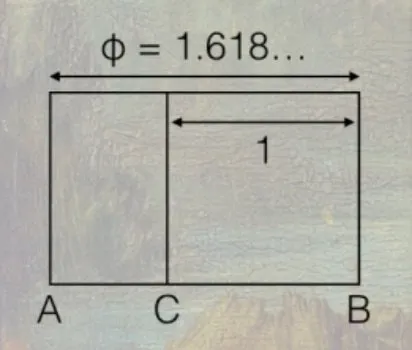
When the proportion is drawn in a rectangle, as shown above, the relevant lengths form the same ratio. Numerically, φ = (1 + √5) / 2, approximately 1.61803. The proportion is therefore 1:1.61803.
Renaissance artists sought an ideal vision of the world through harmonious, balanced compositions. Many aspired to become a Homo Universalis, a person accomplished in many fields. They therefore drew inspiration from mathematics, anatomy and architecture as well as art.
““A good artist is also a mathematician.” Michelangelo”
The Secret of the Golden Ratio
Euclid’s problem can be described as follows. Take a line segment AB and divide it at C. Where should C be placed so that the ratio of the longer section AC to the shorter section BC equals the ratio of the whole line AB to AC? In mathematical terms: AC : BC = AB : AC.
Let BC = b and AC = a. Then a/b = (a+b)/a. The ratio a/b is the golden number, φ. Substituting gives φ = 1 + 1/φ. Multiplying both sides by φ gives φ2 = φ + 1, or φ2 − φ − 1 = 0. This quadratic equation can be solved using the quadratic formula.
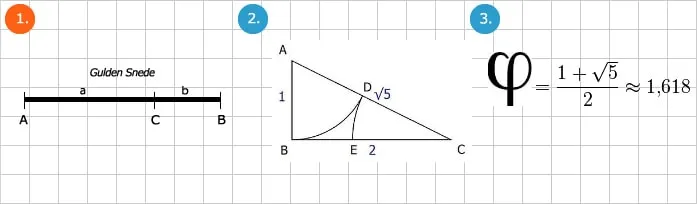
This gives: φ1 = (1+√5)/2 = 1.618033988… and φ2 = (1−√5)/2 = −0.618033988… The positive value means AC is approximately 1.618 times BC, and AB is approximately 1.618 times AC.
Here is a construction of the golden ratio using a compass and ruler:
Draw a right-angled triangle ABC with AB = 1 and BC = 2. By Pythagoras’ theorem, AC = √5.
- Draw a circle centred at A with radius AB, intersecting AC at D.
- Draw a circle centred at C with radius CD, intersecting BC at E.
- Then EC = DC = √5 − 1.
⇒ EC = √5 − 1
⇒ BE = 2 − EC = 2 − (√5 − 1)
⇒ BE = 3 − √5
Therefore BE × BC = 6 − 2√5 = EC2. Thus BE/EC = EC/BC: side BC has been divided in the golden ratio.
The History of the Golden Ratio
An early description appears around 300 BC in Euclid’s Elements, the classical Greek work on mathematics and geometry. Early mathematicians recognised the proportion without calling it the golden ratio. Its mystical associations developed later. In 1509, the Italian mathematician Luca Pacioli published De divina proportione, illustrated by Leonardo da Vinci, celebrating the proportion as an expression of divinely inspired simplicity and order.
Pacioli’s book and Leonardo’s illustrations made the ratio widely known among artists and mathematicians. Later admirers argued that 1.618 is naturally pleasing to the eye, a mathematical expression of beauty, and that proportions based on it have appeared throughout art history.
Supporters often point to nature, including shells and the human body. Such proportions vary considerably, however. Some shells resemble a golden spiral, but not all do. Nautiluses maintain consistent shell proportions as they grow, yet their shells generally form logarithmic spirals rather than a precise expression of phi.
Phi does appear in other natural patterns. Leaf arrangements, pine cones and the spirals of sunflower seeds can approximate the golden ratio. Related arrangements allow efficient packing and help leaves avoid shading one another, with successive leaves separated by a golden angle.
There is no evidence that the golden ratio is inherently superior to other proportions. Artists and designers nevertheless continue to explore it in their search for balance, order and interesting compositions.
Recognising the Golden Ratio in Renaissance Art
The ratio was also called the divine proportion, or sectio divina, because artists, scientists and philosophers regarded it as ideal. It has been rediscovered and described many times. Around 300 BC, Euclid defined the division in his Elements: a line is divided in extreme and mean ratio when the whole is to the larger part as the larger part is to the smaller.
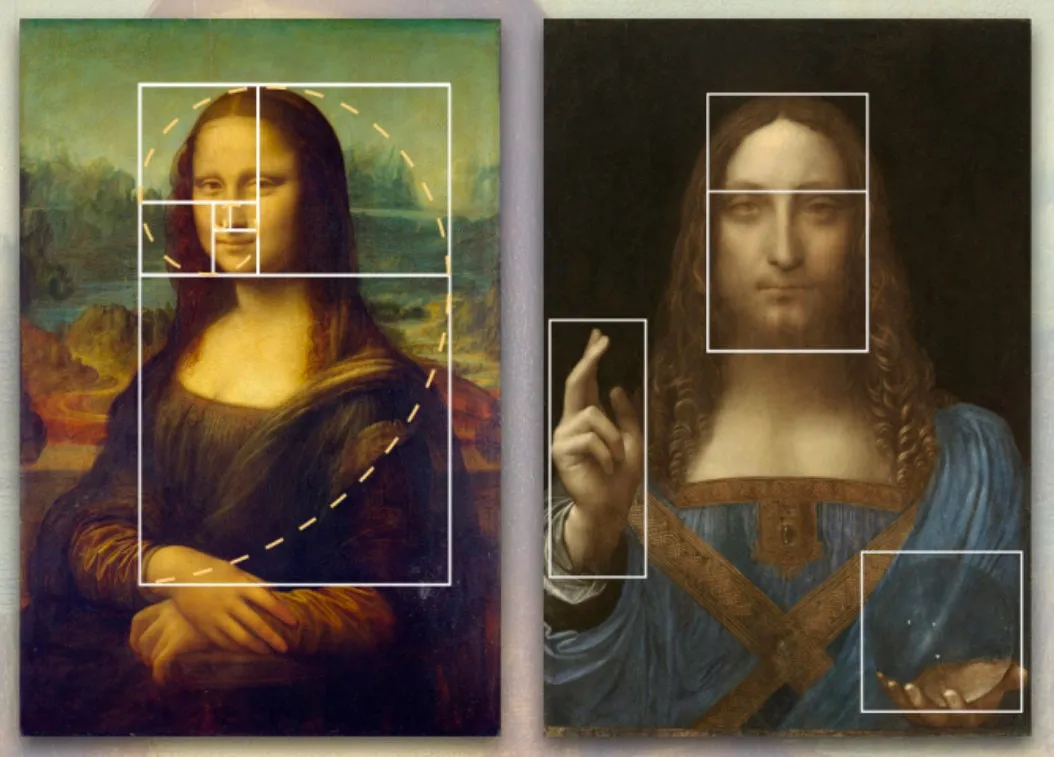
Michelangelo & Leonardo da Vinci
The divine proportion is often discussed in interpretations of Renaissance masterpieces. Leonardo’s portraits are analysed in these terms: in Salvator Mundi, the face, hand and glass sphere are related through such proportional readings. Similar analyses are applied to the Mona Lisa. Nested golden rectangles can be used to draw a spiral following this proportion.
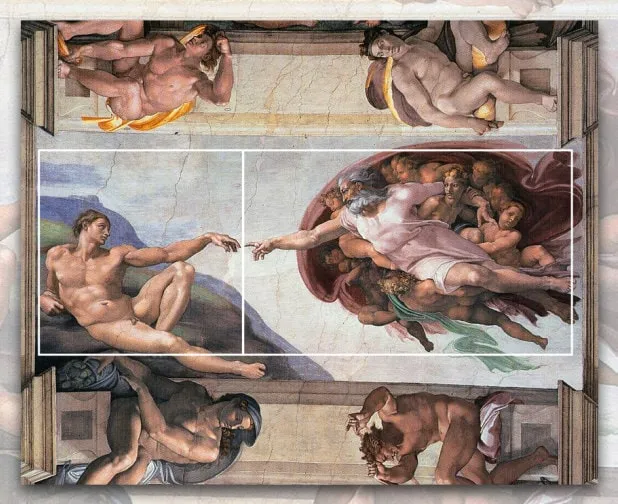
Michelangelo’s Creation of Adam on the ceiling of the Sistine Chapel is also interpreted through the golden ratio, relating the figures of Adam and God and the meeting point of their outstretched fingers.
Raphael
The School of Athens, painted by Raphael in the papal apartments, is another work analysed using the golden ratio. The image below highlights some proposed examples of how these proportions create a harmonious arrangement within the fresco.
The Golden Ratio in Art and Graphic Design
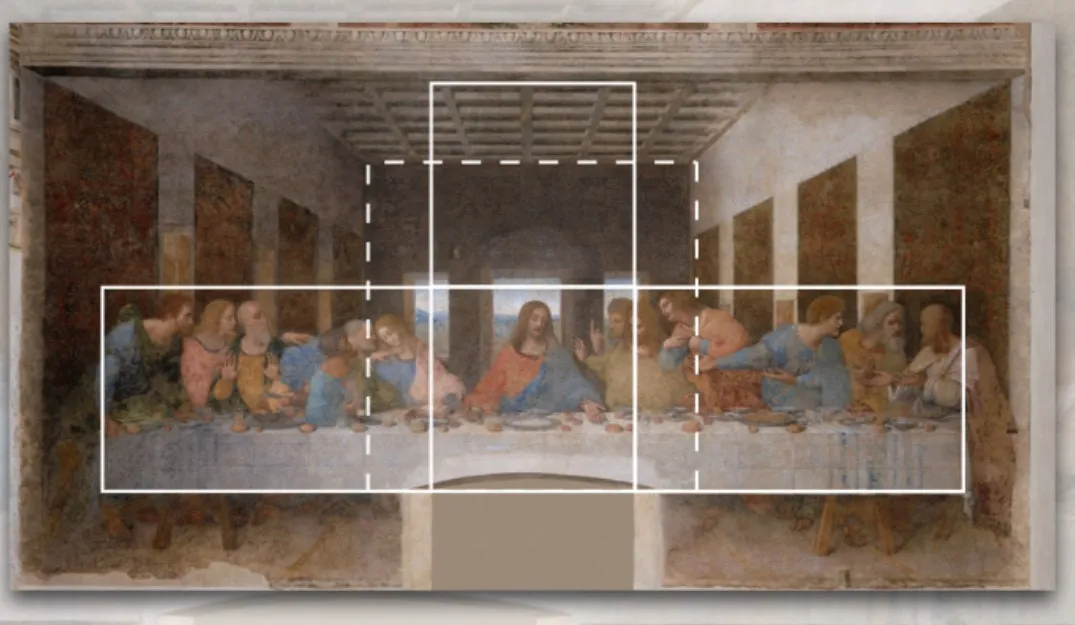
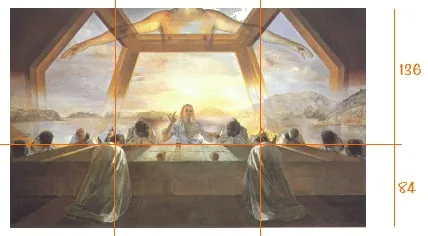
Some artists and designers have deliberately based their work on this ratio. The twentieth-century architect Le Corbusier incorporated it into his proportional system. Salvador Dalí chose a golden-rectangle canvas for The Sacrament of the Last Supper.
Why Did the Golden Ratio Become Less Popular after the Renaissance?
The golden ratio has often been used to create harmony, fitting the idealising aims of Greek and Renaissance art. Later movements, including Baroque and Romanticism, emphasised emotion, movement and drama. The balance associated with the ratio did not always suit these aims.
Modern artists, including Georges Seurat, Piet Mondrian and Salvador Dalí, have also been discussed in relation to the divine proportion. Today it is frequently applied in design, logos and architecture. Some 2,500 years after Euclid, the golden ratio remains a popular subject!
Using the Golden Ratio in Your Work
Aesthetics and design do not obey rigid mathematical laws. A poor design can still follow the golden ratio. Nevertheless, it can provide a useful framework for avoiding clutter and organising a balanced composition.
Like the rule of thirds, it is a compositional guideline rather than an absolute law. Placement matters: always centring images or presenting text as an unaligned block can lose the viewer’s attention. Use the ratio as one possible tool for arranging the elements of your work.
Guidelines such as the rule of thirds and the golden ratio can help create variation and inviting empty spaces, making content easier to understand.
If you choose the golden ratio as a starting point, it may help produce a balanced, pleasing composition. Exact proportions of 1.618 are less important than thoughtful, creative design.
The Golden Ratio in My Work
Over the past ten years, I have specialised in painting with Old Master techniques. The golden ratio particularly interested me, and I read extensively about it. Its proportions gave me a framework for planning my compositions, especially in The Message.